
Stock Vehicle.
Real Trails.
The biggest lie in overlanding? That you need a built rig before you can go anywhere. Here's the truth about what your stock 4x4 can actually handle — and where the real limits are.
Every week, someone posts the same question in every overlanding group on the internet: "Can I go overlanding in my stock truck?" And every week a chorus of well-meaning but overbuilt enthusiasts tells them to buy new tires, add a lift, get a skid plate, mount a winch — before you know it, a $32,000 truck needs $14,000 in mods before it's "trail ready." This post exists to stop that cycle.
The honest answer is yes — with the right expectations, the right routes, and the right mindset, a completely stock capable 4x4 will take you to places that genuinely take your breath away. Overlanding is about the journey, the self-sufficiency, and the wild places you find at the end of a dirt road. None of those things requires a lift kit.
01 — Definition
WHAT "STOCK" ACTUALLY MEANS
When we say "stock" in the overlanding context, we mean a vehicle with factory suspension, factory tires, no aftermarket bumpers, and no underbody armor. Exactly how it rolled off the dealer's lot.
Manufacturers — particularly those targeting the outdoor market — have put real engineering into their off-road variants. A factory Jeep Wrangler Rubicon, Toyota 4Runner TRD Off-Road, Ford Bronco, or Chevy Colorado ZR2 comes with Factory-Installed Off-Road Hardware, Electronic Locking Differentials, Crawl Control, Disconnecting Sway Bars, and All-Terrain Tires — stock features on purpose-built machines.
Not all stock vehicles are created equal. A stock Tacoma TRD Off-Road and a stock Camry are both "unmodified" — but they are not remotely comparable on trail. This guide assumes a capable 4WD or AWD platform, not a sedan or standard crossover.

A stock SUV on a gravel forest road. This is the reality of most overlanding terrain.
02 — Capability
WHAT A STOCK VEHICLE CAN HANDLE
The overwhelming majority of publicly accessible overlanding terrain in the United States is perfectly manageable in a stock-capable 4x4. Bureau of Land Management roads, most USFS two-tracks, and countless dispersed camping routes are graded gravel and dirt — not technical rock crawls.
| Terrain Type | Stock Capable? | Notes |
|---|---|---|
| Graded Gravel/Dirt Roads | Yes | The majority of BLM and USFS routes. Easily managed. |
| Moderate Two-Track with Ruts | Yes | Good line selection and 4-Lo handle most situations. |
| Mild Rocky Terrain | With care | Slow speed, careful line selection, and know your Clearance. |
| Water Crossings (<20 in.) | With care | Check depth first. Slowly enter, and know your Air Intake Height. |
| Snow/Light mud | Situational | Momentum and 4WD work — Deep Soft Conditions can trap you. |
| Technical Rock Crawling | No | Ground Clearance and Approach Angles limit stock vehicles here. |
| Deep Mud or Bog | No | Highway or All-Season Tires lack the paddle traction needed. |
— Dynamite Overlanding
03 — Limitations
THE REAL LIMITS OF GOING STOCK
Understanding your vehicle's real limits before you hit the trail is what keeps you from becoming a recovery story. Here's where stock vehicles run into the ceiling.
Ground Clearance
Factory ground clearance on most capable 4x4s ranges from 8 to 10 inches — enough for forest roads, rutted two-tracks, and mild rocky terrain. Large embedded rocks, deep ledges, and steep off-camber sections will start catching your rocker panels and differentials. This is the first limit you'll discover, usually slowly and not catastrophically.
Tire Performance
Factory all-season or light all-terrain tires are a compromise — designed for pavement first, light dirt second. Sidewalls are thinner and more puncture-prone on rocks, and the tread pattern isn't designed to clear mud or bite into soft surfaces. Proper A/T tires are your first and most impactful upgrade when the time comes.
Approach and Departure Angles
Factory bumpers are designed for pedestrian safety and aerodynamics — not for climbing steep rocky ledges. The front bumper's low overhang limits how steep a climb you can attempt before dragging. Walk a section before driving it and decide honestly whether your geometry clears the obstacle.
No Underbody Protection
Oil pans, transfer cases, and fuel tanks are largely exposed on most stock vehicles. A sharp rock on a rough road can mean an expensive repair miles from anywhere. Drive conservatively, pick smooth lines, and know that skid plates are one of the cheapest and highest-value mods you can add later.
Recovery Limitations
Stock vehicles typically have no dedicated recovery points, no winch mount, and no safe strap attachment. This means being more deliberate about where you take the vehicle — and always carrying traction boards and a rated tow point where your vehicle has one.

The kind of terrain that makes up 80% of real overlanding. No lift kit required.
04 — Platform Comparison
TACOMA / 4RUNNER VS WRANGLER / BRONCO
These four platforms dominate the overlanding scene for good reason — each is genuinely capable straight from the factory. Here's how they compare as stock overlanding vehicles.
Best for: Long-range reliability
Best for: Technical trail capability
Both platforms handle 90% of overlanding routes in completely stock form. The Tacoma and 4Runner edge ahead on long-distance reliability and fuel range. The Wrangler Rubicon and Bronco Badlands win on raw technical capability — arriving from the factory with hardware that most builds take years to add.
05 — Maximize It
HOW TO GET THE MOST FROM YOUR STOCK RIG
Before you spend a single dollar on modifications, these six strategies will dramatically increase what your stock vehicle — and more importantly, what you — can handle on trail.
The single most impactful zero-cost improvement available. Dropping tire pressure from street PSI to trail PSI increases your contact patch, improves traction, and smooths the ride dramatically. Do it every time you leave pavement.
Read the owner's manual sections on 4WD operation. Practice engaging 4-Hi and 4-Lo in your driveway before you need them on a slippery slope. Look up your exact ground clearance and approach angle. Knowing your numbers means knowing your limits.
Use apps like Gaia GPS and Trails Offroad to filter routes by difficulty and surface type. Start with Forest Service and BLM roads rated for standard clearance vehicles. Drive them in daylight before overnighting. The route is your most powerful variable.
Smooth, deliberate inputs beat aggressive throttle every time on trail. Walk difficult sections before you drive them. Choose your line carefully — the right line in a stock vehicle clears obstacles that a bad line in a built rig won't. Slow is smooth. Smooth is fast.
No winch yet? A pair of traction boards, a hi-lift jack, a rated tow strap, and a full-size spare cover the most common self-recovery scenarios. Pair that with a satellite communicator and a solid trip plan left with someone at home.
This is a skill, not a failure. Before every difficult section, ask: "Can I get back out?" If the answer is uncertain, don't go in. The trail will always be there next time. Getting recovered 40 miles from the nearest town won't be forgotten quickly.
05a — Air Down Reference
TIRE PRESSURE QUICK GUIDE
35–40 PSI
28–32 PSI
20–25 PSI
12–18 PSI
10–15 PSI
🔨 Don't Forget to Air Back Up
Running low PSI on pavement damages your tires, hurts fuel economy, and compromises handling. A portable 12V compressor is mandatory if you air down — budget $60–$150 for a reliable unit. It's one of the most useful tools you'll carry.
THE EDGE OF DRIVING STOCK
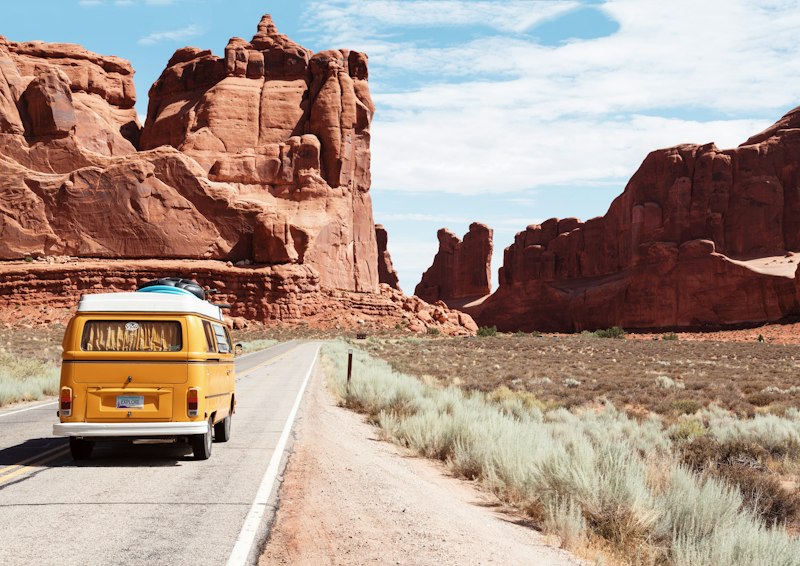

The destination matters more than the vehicle that gets you there.
Here's something the overlanding industry doesn't advertise: driving a stock vehicle teaches you more than driving a built one. When your rig can't brute-force its way through every obstacle, you're forced to actually drive — to read terrain, select lines, manage momentum, and make good decisions. These are the skills that define a genuinely capable overlander.
Every experienced overlander you respect built their instincts by driving vehicles that had limits. The habit of asking "can I get back out?" before committing to a difficult section? That comes from not having a 12,000-lb winch to bail you out. The ability to read a hillside and know exactly where the soft spots are? That comes from having gotten stuck in one before.
— Dynamite Overlanding
WHEN IT'S TIME TO START BUILDING
You'll know when your stock vehicle is genuinely limiting you — not because someone on YouTube says so, but because you'll hit the same problem repeatedly on routes you care about. When that happens, here's a sensible upgrade sequence.
Notice that a lift kit isn't even step two. All-terrain tires transform a stock vehicle's traction, puncture resistance, and trail confidence more than any other single modification. If you're spending money on one thing first, spend it there. Everything else is incremental.
- A/T tires — biggest traction upgrade available
- Portable Air Compressor — required if you air down
- Traction Boards (x2) — self-recovery essentials
- Full-Sized Spare, not a donut
- Skid Plate Kit — oil pan and transfer case first
- Satellite Communicator — non-negotiable solo
- Hi-Lift Jack + Base Plate
- Recovery Straps + rated shackles
- Jump starter + tire plug kit
- First Aid Kit for remote travel
- Water — 3 days minimum for the route's range
- Downloaded Offline Maps/Paper backup
Conclusion
YOUR STOCK VEHICLE IS TRAIL READY RIGHT NOW
The best overlanding trip you've ever had is waiting for you at the end of a dirt road your stock vehicle can drive today. Not after the lift. Not after the new tires. Not after the bumper and the winch. Today.
Overlanding has always been about self-sufficiency, exploration, and the freedom that comes from going somewhere most people never bother to go. None of that requires a modified vehicle. It requires preparation, respect for the terrain, the discipline to know your limits, and the willingness to turn around when you've reached them.
Build your rig over time as you genuinely discover what you need. But don't let the build stand between you and the trail. Get out there first — the rest will follow naturally.
When your stock rig starts showing its limits, read our guide to essential overlanding mods under $1,000 — where to spend first and what to skip.